





Wall of Worry or Death by a Thousand Cuts?
Equity market turbulence has felt quite jarring, though stocks are only about 3% below an all-time high. The VIX remains below 20, and since June 1, stocks have been range-bound with a max gain of 2.9% and a max loss of 4.4% from the June 1st close of 7,600 for the S&P 500.
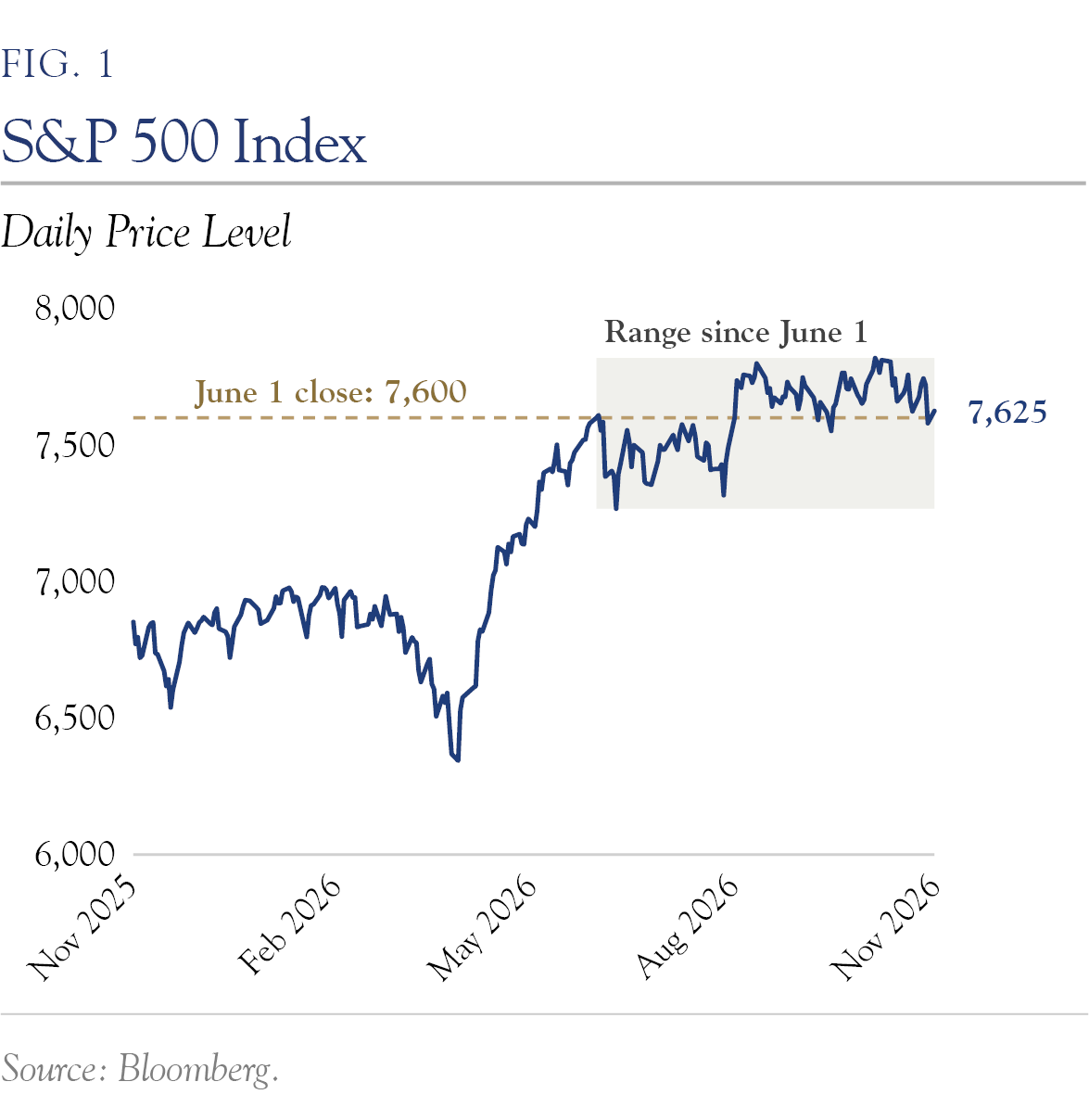
With an array of consequential issues yet to be decided, the equity market could climb a wall of worry or face a death by a thousand cuts.
Five Unsolved Mysteries
1. Will the path from AI eventually lead to productivity and earnings gains for a broader segment of the economy?
We think so, but the process is unfolding more slowly than most expected. Clarity is unlikely until the first half of 2027.
2. Will a slowing earnings growth rate lead to tech companies being priced with an element of cyclicality?
We believe some of the compression in Price/Earnings (P/E) ratios for tech companies reflects an assumption that some growth is cyclical. While P/Es are likely to stabilize, we may have seen peak P/Es on tech earnings.
3. Will construction timelines meet expectations for data centers? Will politics and supply chain issues slow the process and reduce rates of return?
We expect data center construction to unfold more slowly than expected. This will weigh on returns for many participants and lead to a shakeout among weaker participants across financing, construction, and ongoing data center management.
4. Will pricing of compute/tokens fall? What will this do to demand? Corporates are becoming more cost-conscious; does that matter for expected revenue of the frontier models?
We expect prices to decline, usage to increase, and competition to be intense across models. It will be difficult for the models to capture the bulk of economic benefit. Rather, benefits should shift gradually to users of the technology. Signs of this are expected throughout 2027.
5. Will military conflict resume or intensify in the Strait of Hormuz following the election? Does this lead to even higher oil prices and inflation?
It is impossible to predict whether military conflict will intensify. The conflict in the Strait of Hormuz and pressure on oil prices will likely persist, making it unlikely that inflation will ease, or that the Fed will cut rates, in the near term.
Many of these critical questions will see some form of resolution in coming months and quarters. As such, we continue to emphasize a risk posture that is neutral to long-term targets and heavily diversified. Risks of both positive and negative outlier outcomes have risen, so alternative risk mitigation techniques may also be useful, especially for more complex portfolios.
Tech Battleground
The core battleground for equity market direction is the tech sector. On the one hand, earnings growth is robust. On the other hand, open questions remain about how long the growth will last and how much to pay for it.
Often, the P/E ratio is used to assess valuation. However, with tech posting some of the strongest earnings growth rates in history, a higher valuation might be merited. Another technique is the PEG ratio, which measures P/E divided by growth. For example, a P/E of 20 with 20% earnings growth yields a PEG of 1.0. For the Tech sector, throughout most of 2024 and 2025, this metric hovered between 2.0x and 2.5x. Throughout 2026, earnings growth has been robust, the P/E ratio has declined, and PEG has dropped to just under 1.0x.
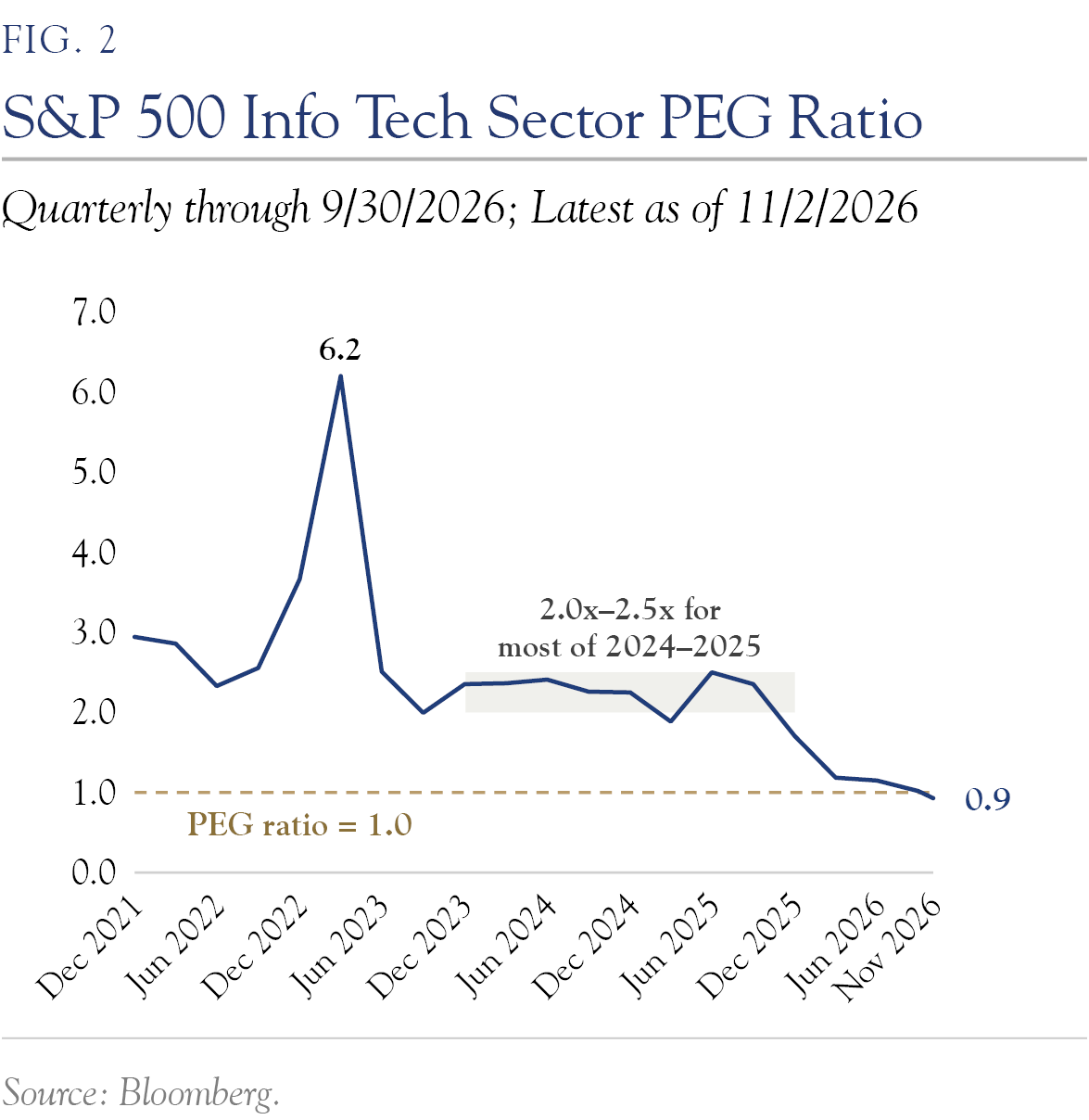
The most bullish interpretation is that a variety of macro issues (such as interest rates) are temporarily depressing valuation metrics. When that cloud dissipates, tech multiples will move higher, bringing stock prices higher.
Our view is more cautious. Yes, strong earnings growth will continue, though the growth rate may slow.
More concerning is the dramatic increase in spending to build AI capabilities. While the investments may well prove quite lucrative, the sector is suffering a sea change, as cash flows shift from positive to negative.
Another point of contention is the timeline for converting investment into productivity and earnings. Erik Brynjolfsson’s work on the productivity J-curve provides important context for the not-so-simple path to profitability for a new technology. Even so, patience wanes as investors seek clear signals from management teams that the investments are paying off.
As questions mount, the natural response is to shift from viewing the sector as a predictable, “bulletproof” cash-flow machine to a riskier proposition with embedded cyclicality, given that the AI buildout will eventually ebb.
Outlook
Overall, we view recent jitters in the equity market and decline in valuation as a reasonable response to a central issue (AI) that has become more complicated. This backdrop informs our view of a balanced risk outlook, aiming to be at long-term risk targets with robust diversification.
The coming quarters will bring clarity to the numerous questions that have emerged about the economy and markets.
In addition to staying tuned for the resolution of these questions, look out for our upcoming U.S. and Global Outlook 2027 & Beyond, scheduled for release in the coming weeks.
This communication contains the personal opinions, as of the date set forth herein, about the securities, investments and/or economic subjects discussed by Mr. Teeter. No part of Mr. Teeter’s compensation was, is or will be related to any specific views contained in these materials. This communication is intended for information purposes only and does not recommend or solicit the purchase or sale of specific securities or investment services. Readers should not infer or assume that any securities, sectors or markets described were or will be profitable or are appropriate to meet the objectives, situation or needs of a particular individual or family, as the implementation of any financial strategy should only be made after consultation with your attorney, tax advisor and investment advisor. All material presented is compiled from sources believed to be reliable, but accuracy or completeness cannot be guaranteed. © Silvercrest Asset Management Group LLC