





This nuclear renaissance is not merely about replacing coal plants or cutting carbon; it is about fueling the engines of the future.
The world is standing at the crossroads of two revolutions: one in energy and one in technology. As the demand for clean, reliable power intensifies, nuclear energy—long viewed with skepticism—is being reborn as a cornerstone of the global transition. This nuclear renaissance is not merely about replacing coal plants or cutting carbon; it is about fueling the engines of the future, from the electrification of everything to the energy-hungry data centers that power artificial intelligence. As global electricity demand rises at the fastest pace in decades, an “all hands on deck” approach is needed. With new reactor designs that are safer, smaller, and more efficient, nuclear power is coming out of the doldrums and emerging as a critical force in meeting humanity’s twin imperatives: producing clean energy and powering the digital age.
Nuclear’s Rise, Peak, & Decline
At its peak in the mid-1980s, prior to the Chernobyl disaster in 1986, nuclear power represented around 17% of total global electricity supply.
Back in the 1970s and 1980s, nuclear power was a meaningful generator of global electricity. Global nuclear capacity represented approximately 15 gigawatts (GW) of power in 1970, increased to over 100 GW by 1980, and surpassed 300 GW by 1990. At its peak in the mid-1980s, prior to the Chernobyl disaster in 1986, nuclear power represented around 17% of total global electricity supply. Expansion subsequently slowed in the 1990s due to safety concerns, rising costs, and public opposition. Today, less than 10% of global electricity comes from nuclear power supply, according to the International Energy Agency (IEA).
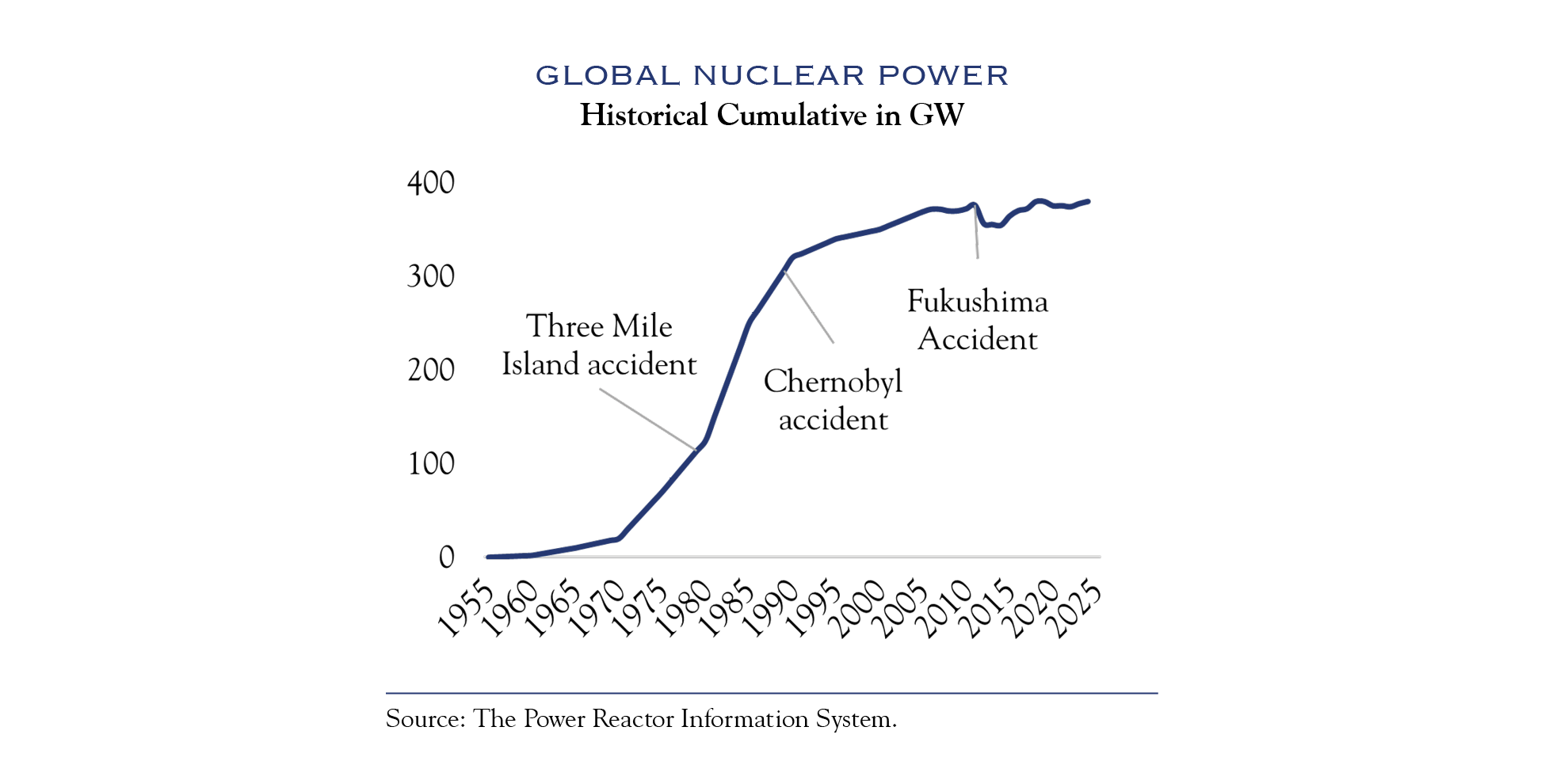
The shift away from nuclear accelerated in the 2000s. New nuclear builds became more expensive and slower to develop due to complex safety regulations, bespoke reactor designs, and financing challenges. In turn, the cost of solar modules and wind turbines plummeted. Since 2010, utility-scale solar and onshore wind costs per megawatt-hour of electricity generated have declined by more than –80% and –60%, respectively. Solar and wind projects can be permitted and built within a couple of years, whereas nuclear plants have historically taken upwards of 10 years or more from planning to commissioning.
How Nuclear is Staging a Comeback
Fast forward to today, and nuclear energy is staging a comeback after decades of stagnation. While solar and wind have become the fastest-growing sources of electricity, their variability creates problems for grid reliability. Even with falling battery costs, large-scale storage remains expensive and limited to hours rather than days or weeks. For countries facing rising baseload electricity demand—whether from heavy industry, urbanization, or the rapid growth of data centers—nuclear offers the kind of round-the-clock, carbon-free power that stabilizes renewable-heavy grids. It is no coincidence that nearly every major climate scenario from the IEA and Intergovernmental Panel on Climate Change that reaches net-zero by 2050 includes a substantial role for nuclear alongside renewables. Without nuclear, the cost of overbuilding solar and wind capacity and the storage to back them up would be prohibitive.
With data centers projected to consume a double-digit share of global power by 2030, nuclear power is uniquely suited to support this growth
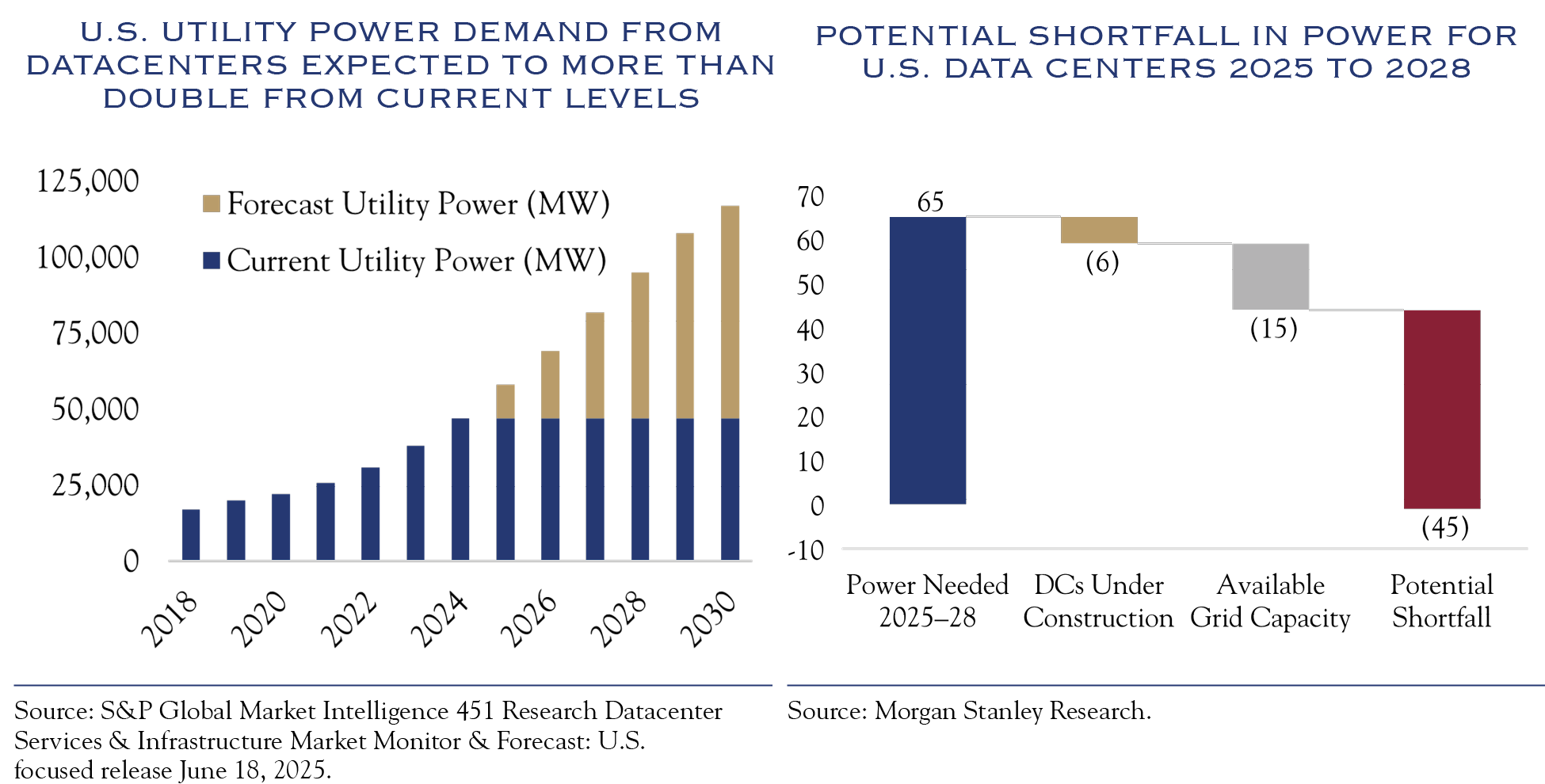
The digital revolution, and particularly the rise of artificial intelligence, is amplifying this urgency to revitalize nuclear power. Training large AI models and running inference workloads demands enormous and, perhaps most importantly, continuous electricity. Simply, the hyperscaler load profile is unforgiving: AI clusters run flat out, with utilization at approximately 85%. The existing U.S. fleet of nuclear reactors averages a roughly 93% capacity factor, according to a U.S. Energy Information Administration (EIA) report in 2024, compared with just 40% for natural gas combined cycle and 35% for wind. With data centers projected to consume a double-digit share of global power by 2030, nuclear power is uniquely suited to support this growth, offering stable, carbon-free baseload generation that ensures both grid resilience and decarbonized digital infrastructure. New reactor technologies are even designed with these needs in mind. Small Modular Reactors (SMRs), for instance, can be co-located with large-scale data centers, while microreactors offer distributed solutions for more localized AI infrastructure. These systems can also integrate with renewables and hydrogen production to balance peak loads, making them highly versatile in a changing energy ecosystem.
Technological & Safety Improvements
The urgent need for nuclear is increasingly recognized. Yet, regaining public trust around the resource’s safety and dependability undoubtedly remains paramount. One of the most important drivers of nuclear’s revival is the transformation in safety and technology. The new generation of reactors—such as SMRs and Gen IV designs—incorporate passive safety systems that can shut down automatically without human intervention, dramatically reducing the risk of accidents. Advanced fuel cycles are being developed to minimize waste and improve efficiency, while progress in fusion research holds out the long-term promise of virtually limitless, inherently safe energy. These innovations directly address the criticisms that stalled nuclear power in the past: public fears about safety, political resistance to waste storage, and concerns about proliferation.
While challenges like upfront costs and waste management remain, the shift in technology is making nuclear not only a cleaner option, but a more secure and socially acceptable one, opening the door to its renewed role in the global energy mix.
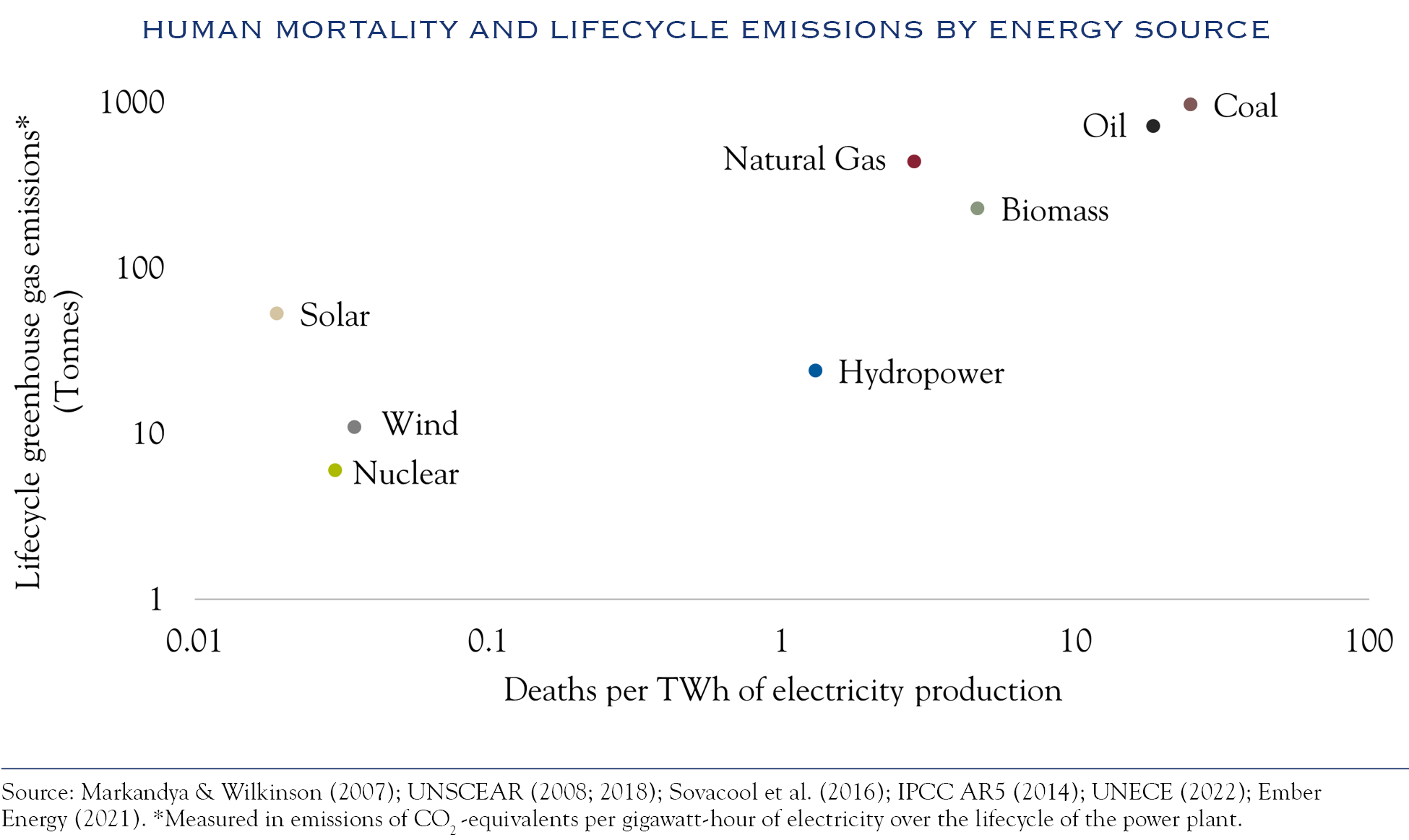
Addressing safety, consider this. Measured in deaths per terawatt-hour, nuclear energy causes just 0.03 deaths, a rate lower than wind and only slightly higher than solar. By contrast, fossil fuels are orders of magnitude more dangerous: coal results in 24.6 deaths per terawatt-hour, oil 18.4, and natural gas 2.8, respectively. The picture is just as striking when looking at greenhouse gas emissions. Nuclear produces only 6 tonnes of CO2 per gigawatt-hour, compared to 970 tonnes for coal, 720 for oil, and 440 for natural gas, respectively. Even biomass, often considered “renewable,” emits far more and causes higher death rates. These comparisons show that nuclear is not the risky outlier it is often portrayed to be. Rather, it combines ultra-low emissions with safety levels on par with or better than most renewables. By demonstrating that modern nuclear technology is safer, more reliable, and more adaptable than its predecessors, the industry is working to rebuild public trust. While challenges like upfront costs and waste management remain, the shift in technology is making nuclear not only a cleaner option but a more secure and socially acceptable one, opening the door to its renewed role in the global energy mix.
Global & U.S. Policy Acceleration
While we are still early in the days of this resurgence in nuclear power, momentum is building quickly. In the United States, the federal government has moved aggressively to reinvigorate nuclear energy as a pillar of national energy, industrial, and security policy. The ADVANCE Act from 2024 directs the Nuclear Regulatory Commission (NRC) to cut licensing reviews from more than three years to 18 months. The Department of Energy (DOE) has committed more than $14 billion since 2020 to demonstrations, loan guarantees, and supply chain build-out. President Trump’s 2025 executive orders go further, targeting a quadrupling of U.S. nuclear capacity from 100 GW today to 400 GW by 2050. In line with this ambitious plan, the U.S. government struck an $80 billion investment with critical industry players to build 10 large-scale reactors by 2030. At the same time, hundreds of state-level policies across nearly half the states in the country are reconsidering nuclear for clean energy, grid reliability, and economic development.
31 countries pledged to triple global nuclear capacity by mid-century. On the corporate side, major hyperscale companies have entered nuclear power deals, including the planned restart of previously idled plants, to secure low-carbon baseload for their growth in AI and cloud services as early as the late 2020s and early 2030s.
Internationally, at the COP29 climate summit in November 2024, 31 countries pledged to triple global nuclear capacity by mid-century. On the corporate side, major hyperscale companies have entered nuclear power deals, including the planned restart of previously idled plants, to secure low-carbon baseload for their growth in AI and cloud services as early as the late 2020s and early 2030s. The IEA projects global nuclear generating capacity to increase from 420 GW in 2024 to 574 GW by 2035. The total nuclear fleet of roughly 440 nuclear reactors today is set to reach 500 by 2030, with another 400 additional reactors in the planning or proposal stage, according to the World Nuclear Association.
Taken together, these initiatives show a clear alignment: significant policy push accompanied by firm industry commitments to expand and modernize global nuclear capacity. Nuclear is no longer viewed as an alternative to renewables, but as an indispensable partner in building a resilient, decarbonized, and digitally powered future.
Conclusion
As the world faces unprecedented electricity demand from industrialization, electrification, and the explosive rise of artificial intelligence, nuclear power is uniquely positioned to help close the gap. Following decades of sitting in the background, the message going forward is clear: nuclear energy is not just making a comeback, it is staging a global surge of investment and innovation that could power the massive energy needs of the 21st century while driving a clean, secure, and digitally enabled future.
This communication contains the personal opinions, as of the date set forth herein, about the securities, investments and/or economic subjects discussed by Mr. Rama. No part of Mr. Rama’s compensation was, is or will be related to any specific views contained in these materials. This communication is intended for information purposes only and does not recommend or solicit the purchase or sale of specific securities or investment services. Readers should not infer or assume that any securities, sectors or markets described were or will be profitable or are appropriate to meet the objectives, situation or needs of a particular individual or family, as the implementation of any financial strategy should only be made after consultation with your attorney, tax advisor and investment advisor. All material presented is compiled from sources believed to be reliable, but accuracy or completeness cannot be guaranteed. © Silvercrest Asset Management Group LLC