





An important trend is emerging whereby investors are evaluating earnings releases with a microscope rather than a telescope. Taking a detailed look at current information, rather than looking far ahead, will have important implications for rotation away from stocks that have been powering the market and for diversifying equity portfolios.
In past years, investors were willing to use a telescope to look farther into the future, greeting multi-year AI buildout plans with enthusiasm. These locked-in revenue streams are great news for the recipients and, to date, have been tolerated by the spenders with the expectation of strong ROI in the future. The apparent view from the telescope: strong earnings as far as the eye can see.
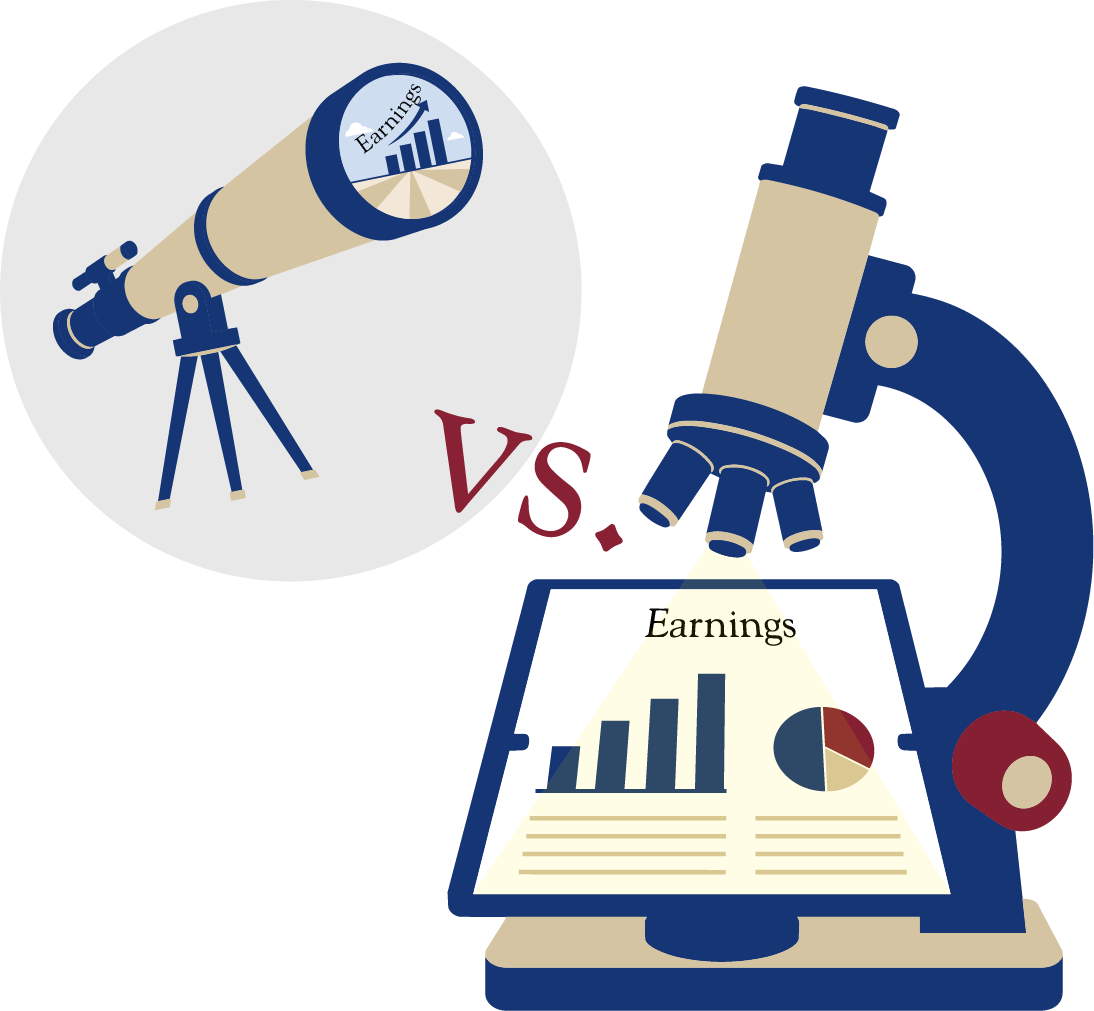
Over the past few quarters, however, we have seen increasing instances of investors putting earnings and news releases under the microscope. This is a healthy development, leading to a closer examination of how much good news is already priced in and a more rigorous questioning of key assumptions embedded in earnings. There is also increased attention on significant changes in cash flow profile, questions about gains from markups on held securities, inquiries over the details of financing arrangements, and so on. While the “circular financing” arguments have echoes of the 1990s, the practice has been relatively limited in comparison to that decade’s broad-based explosion in financial engineering.
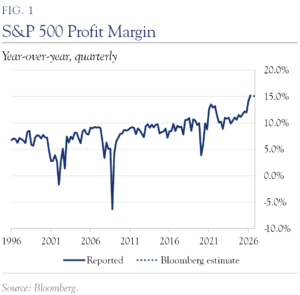
A powerful positive theme from recent earnings seasons has been sales figures that are mostly in line with estimates, while earnings rocket higher. This demonstrates that the analyst community continues to underestimate the ability of companies to boost profit margins. Despite repeated predictions that profit margins had peaked, they continue to rise. We attribute this to a combination of pandemic-era learnings, management innovation, and, importantly, continued use of technology to limit labor expansion relative to revenue expansion.
A more cautious note comes from a pattern similar to last quarter, in which stock price responses lag behind earnings surprises, despite a large magnitude of upside surprise. Last quarter, tech saw a +9.1% upside surprise in earnings, with positive stock price performances of +2.8%. This quarter, while early, the earnings surprise is even larger, yet the stock responses are more muted. Both metrics, while imperfect, indicate that good news and future expectations are already mostly priced in.
The result has been increased volatility and rotation across sectors and market caps, which we expect to continue.
The global macro backdrop is also fueling volatility. The on-again, off-again war in Iran and resulting moves in oil prices are causing uncertainty for the outlook on consumer spending and inflation. Further, the Federal Open Market Committee meeting highlighted three concerns:
- Inflation remains well above target, with no easy path to 2.0%. While the decision was made to hold the Fed Funds rate flat, three voting members dissented, preferring an increase in interest rates.
- While we expect rate policy to remain on hold, the increase in yields following the Fed meeting and the potential for rate hikes will exert downward pressure on valuations for equities until the path ahead becomes clearer.
- The combination of a new Fed Chair, a different communication strategy, and a complex backdrop for rate policy combine to increase uncertainty around, or at least reduce the reliability of, the metrics by which market participants can gauge how the Fed might respond to various conditions. This uptick in uncertainty, which is, in our view, partly attributable to the environment and partly due to changes in Fed communications, is likely to be viewed negatively in the short term.
Nonetheless, we expect policy to remain on hold and not exert any long-term pressure on bonds or equities.
Outlook
Despite a choppy equity market and an unsettled geopolitical backdrop, a stable economy and strong earnings gains will allow amply diversified investors to prevail with a “risk-neutral” posture.
Our three-phase analysis of AI seems to be playing out, as analysts are now focusing not only on the “picks and shovels” plays or the hyperscalers but also on companies whose business models are productively integrating AI. We believe this will lead to renewed focus on the execution ability of management teams. Nine of eleven S&P 500 sectors have margins above where they were one year ago. Although tech is leading the charge in margin expansion, the median sector is also showing gains. Market breadth has improved, and investors seem more willing to rotate than to abandon equities.
One concern is the frequency of weak stock price responses to strong earnings gains throughout earnings season. This makes us more cautious than what the economy’s fundamentals and earnings alone would suggest. At this time, earnings growth rates are likely to keep even wary investors comfortable, boosted by a combination of turbo-charged AI spend and broad-based margin expansion.
Our outlook is for range-bound rates, continued volatility in equity and bond markets, and modest equity gains supported by earnings. To avoid trying to time the AI trade, we prefer a “risk-neutral” posture with ample diversification across sectors, market cap, and geography.
This communication contains the personal opinions, as of the date set forth herein, about the securities, investments and/or economic subjects discussed by Mr. Teeter. No part of Mr. Teeter’s compensation was, is or will be related to any specific views contained in these materials. This communication is intended for information purposes only and does not recommend or solicit the purchase or sale of specific securities or investment services. Readers should not infer or assume that any securities, sectors or markets described were or will be profitable or are appropriate to meet the objectives, situation or needs of a particular individual or family, as the implementation of any financial strategy should only be made after consultation with your attorney, tax advisor and investment advisor. All material presented is compiled from sources believed to be reliable, but accuracy or completeness cannot be guaranteed. © Silvercrest Asset Management Group LLC