





Yields above five! Yields above five!
In December 1808, in an uncomfortably cold venue, Ludwig van Beethoven’s Symphony No. 5 premiered in the middle of a four-hour lineup of Beethoven-conducted performances. Reports from the time note that the orchestra was ill-prepared that evening, with stoppages during at least one performance. Contemporaneous reviews weren’t especially favorable. However, for anyone looking closely enough, the seeds of future popularity were in place. Just as Beethoven was forging a new path with less formality and more expression, the global economy was on a new path as well. The Industrial Revolution brought spectacular innovation while wars created challenges from elevated debt levels. The conflict between old ways and new approaches and the tension between economic innovation and the debt of yesterday’s problems also characterize today’s global economic and market backdrop.
Fed Chair Warsh recently bounded onto the scene, bringing hope for lower rates yet receiving lukewarm reviews for a stark change in communication policy. Will his work to combat inflation ultimately be viewed as a masterpiece, or a flop? As he premieres Rate Hike No. 1, it helps to review the historical implications of different interest rate and inflation regimes.
We examined nearly 700 monthly data points, grouped by yield ( >5%, <5%) and inflation (>3%, <3%), calculating the median monthly S&P 500 return for each regime.
Regime I: Low inflation, low yields. This is generally a perfect backdrop for equities. So long as economic growth is present, valuation metrics can expand. Equities are positive in 70% of months in this regime.
Regime II: High inflation, low yields. An example is 2022, when the Fed was “behind the curve” on inflation. This adjustment period is often painful for equities.
Regime III: Low inflation, but yields high. This is similar to the 1990s experience, where the economy could “tolerate” higher rates; yields weren’t a problem as growth was strong and inflation was contained.
Regime IV: High inflation, high yields. Historically, this has been a stagflationary backdrop, with prominent examples in the 1970s and the early 1990s, at the tail end of the high-rates era. This regime sees higher-than-average volatility and the worst negative month. Still, it remains a period of positive average and median returns and posts positive equity returns in 58% of months.
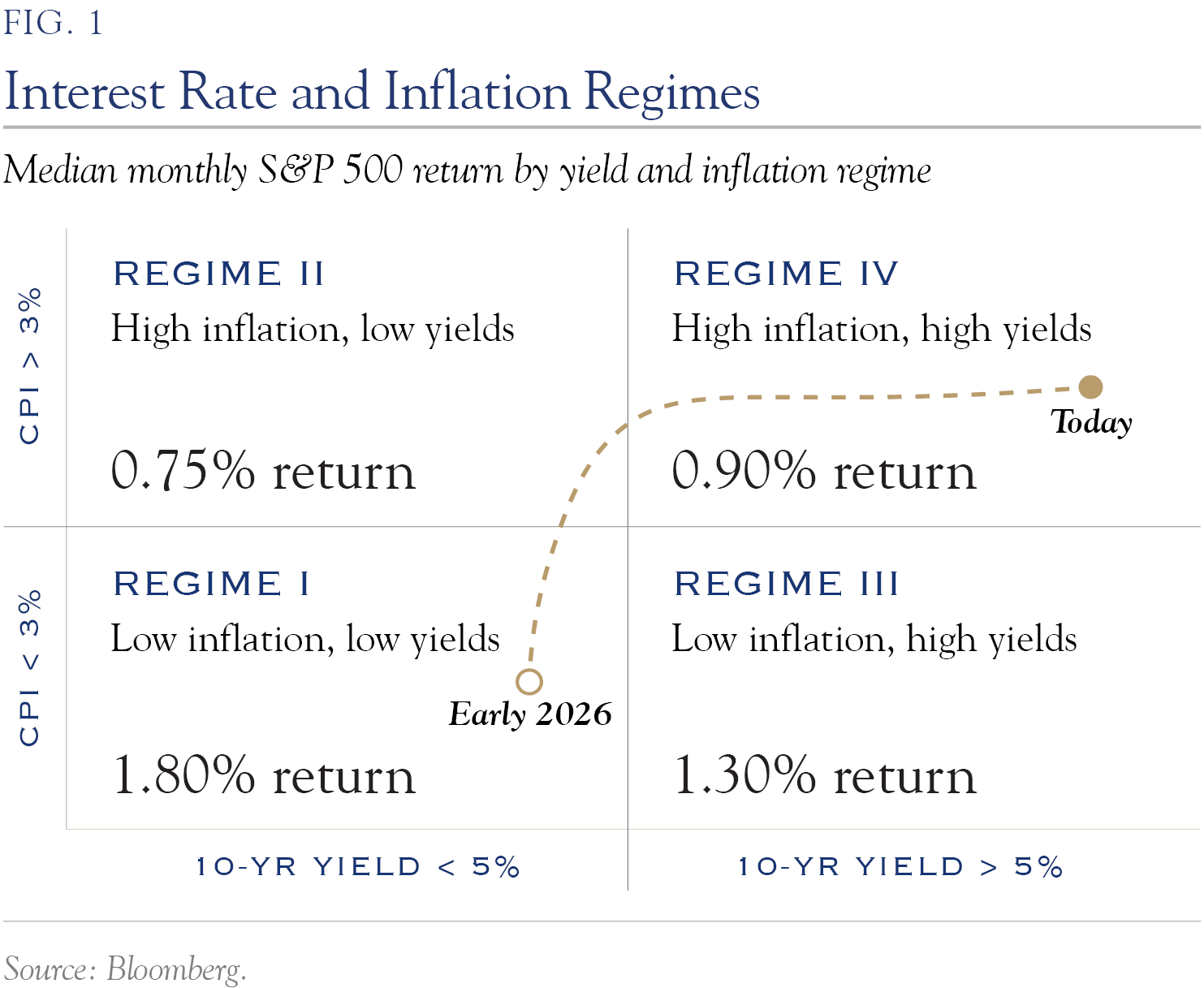
Earlier this year, conditions were in Regime I, with yields below 5% and inflation below 3%. Presently, conditions are in Regime IV as inflation has ticked up and yields are now above 5%. While this doesn’t definitively indicate trouble is ahead, especially because economic growth is strong, it does mean the stakes are higher for earnings gains to carry equities forward. Volatility could be on the horizon, as there is less margin for error when both inflation and rates are in an uncomfortable configuration.
Excellent Earnings—great results, high expectations, will they deliver?
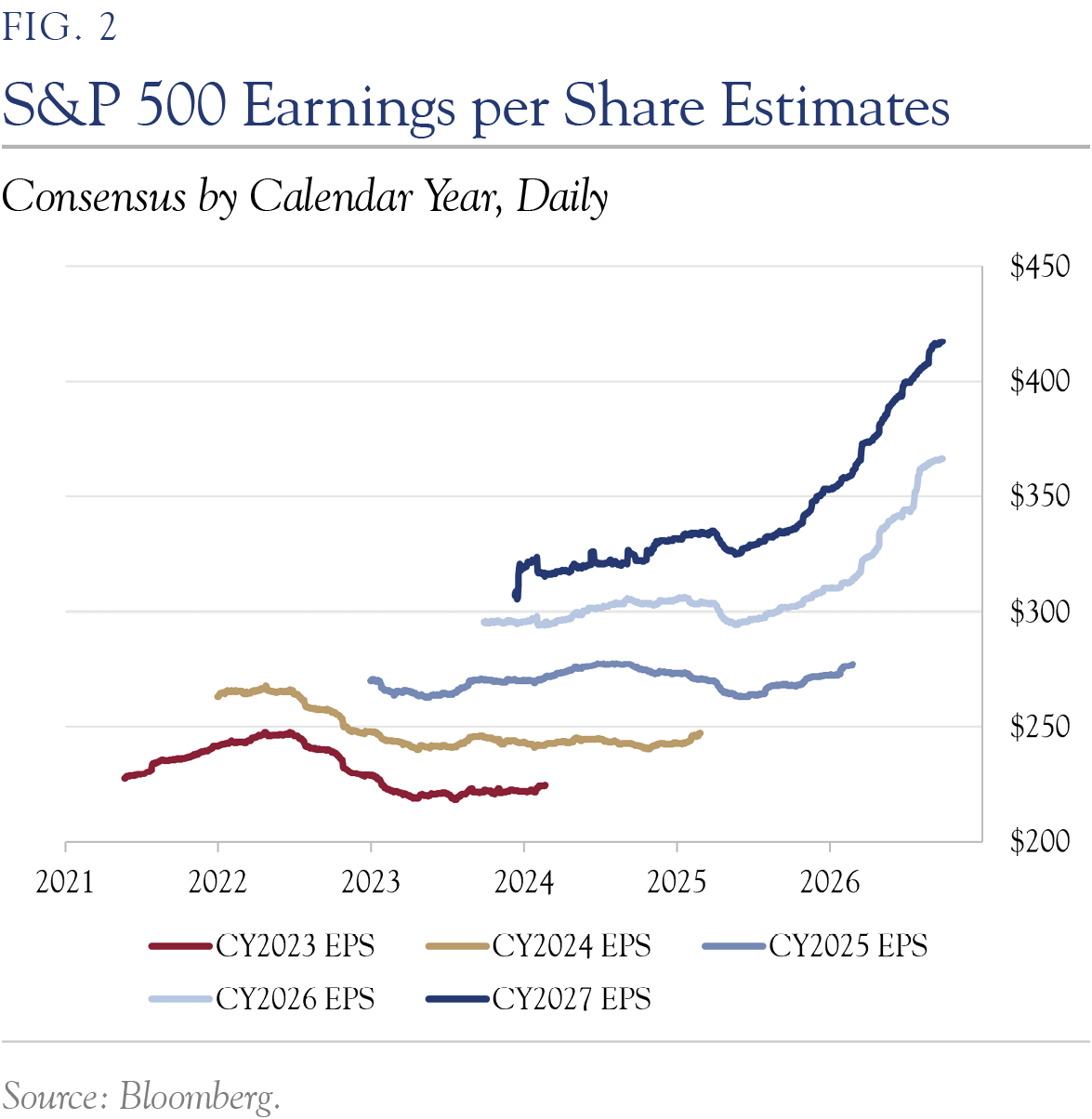
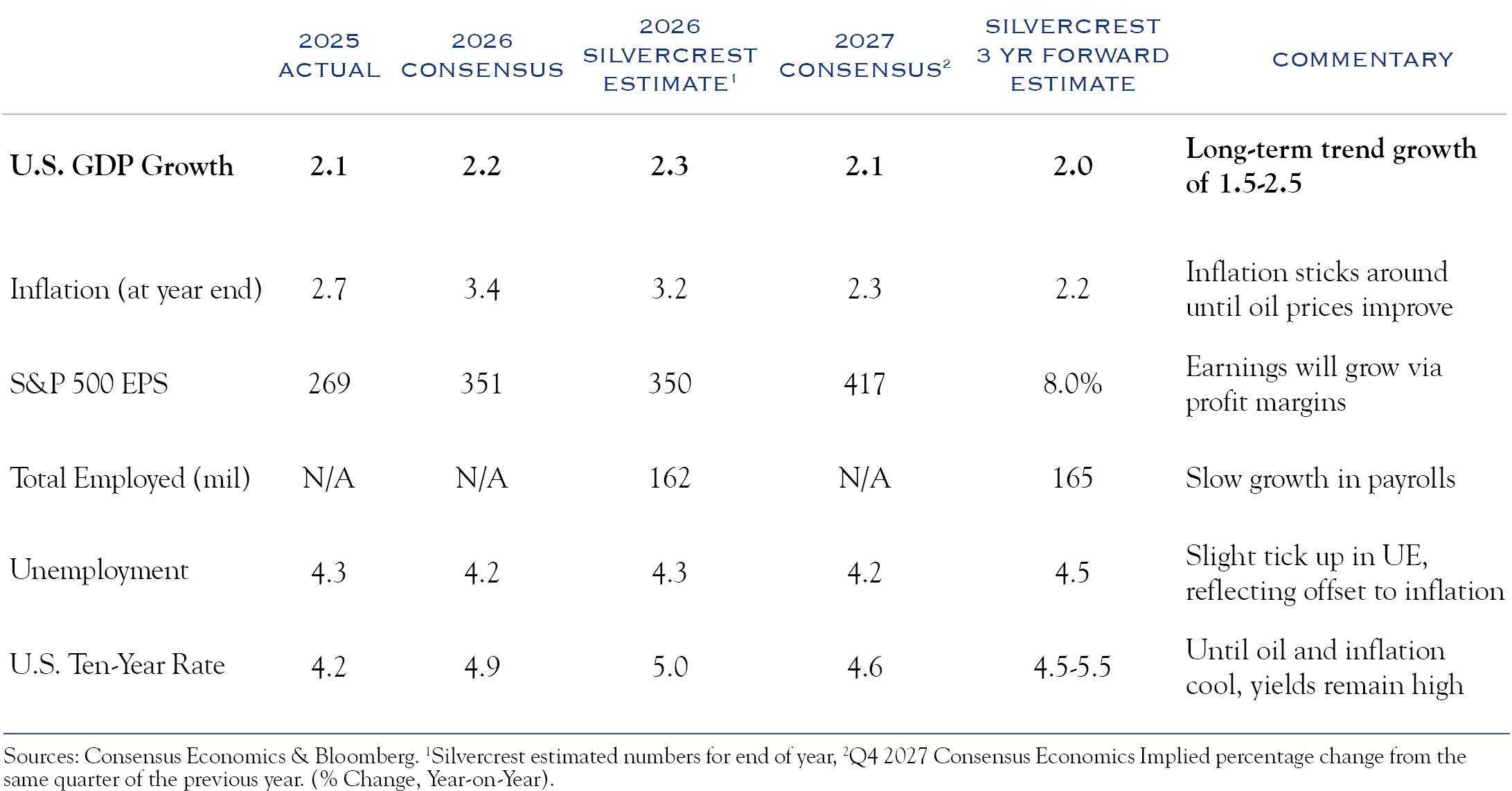
When earnings season gets underway in mid-October, we will be highly attuned to stock price movements in response to announcements. Consensus expectations reflect very strong (yet reasonable) growth. A combination of multi-year trends in profit margin expansion, solid economic activity, and a sector composition that shifts toward more profitable areas is likely to deliver strong earnings growth. If there is any sign that growth is slowing or isn’t good enough to match investor enthusiasm, caution could be warranted. While we are a bit concerned that expectations are running so high, we think earnings will again deliver fuel for equities. As we outlined back in 2024, the AI revolution is unfolding in three phases: infrastructure, models, and users. We expect eventual widespread usage and productivity gains. Figure 2 shows the progression of earnings estimates in recent calendar years, with the obvious acceleration in recent months for 2026 and 2027 calendar year earnings. 2027 estimates are now at $417/share for S&P 500 earnings. At recent levels, this equates to an 18.4x P/E ratio.
Adequate Economy—strong overall, stress building from real wages
Economic conditions remain quite solid, with growth boosted by the AI buildout and a stable labor market, paired with wealth-effect gains that are boosting aggregate consumer spending.
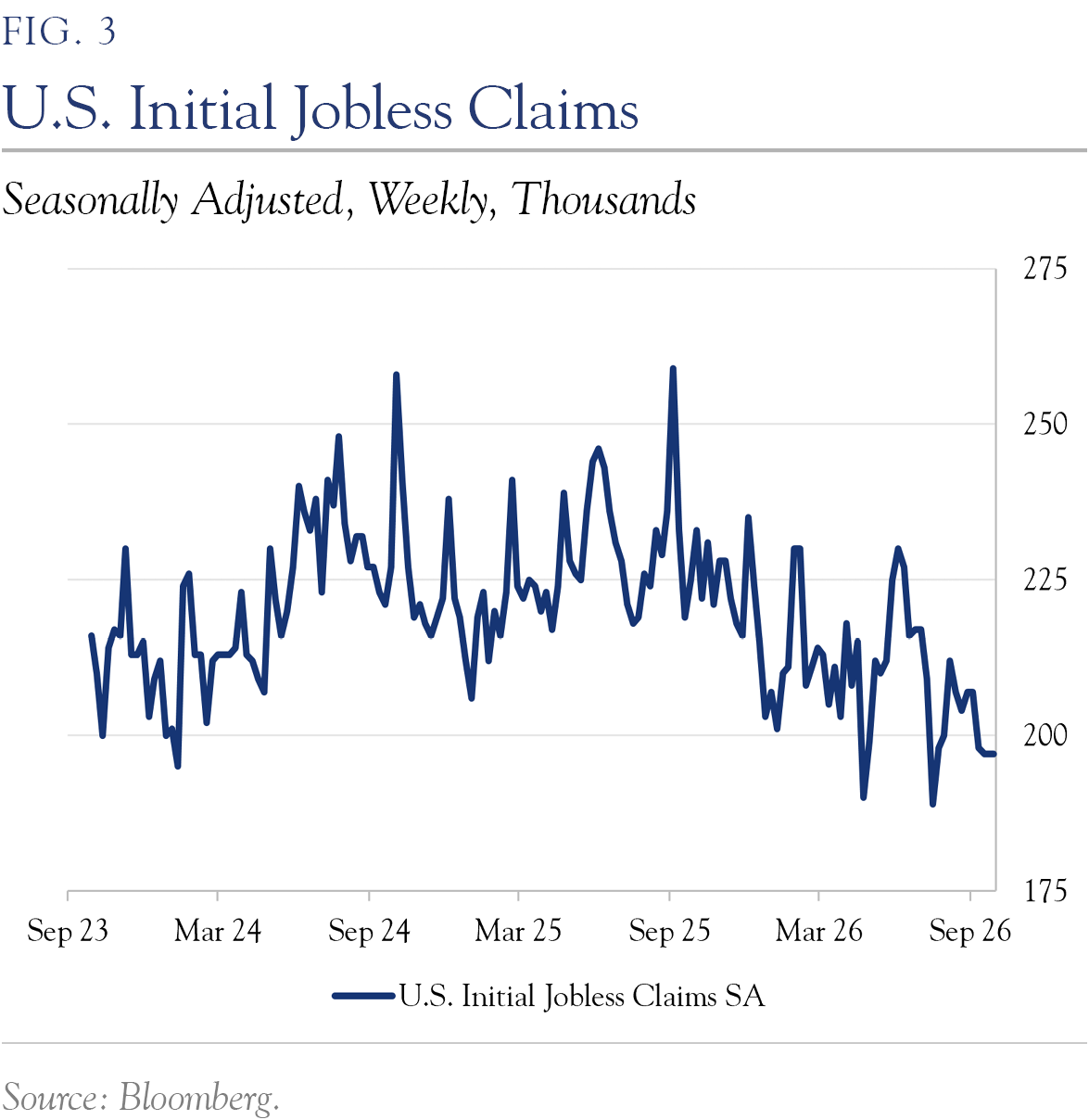
The BLS JOLTS hires rate and monthly non-farm payroll figures indicate that employment continues to expand. Figure 3 shows the trend toward fewer layoffs in recent months. With weekly jobless claims continuing to show very little layoff activity, consumers can generally feel confident in their income and spending choices.
One area of rising stress for consumers is the gap between wage gains of +3.1% in average hourly earnings and inflation, currently running at +3.4%. Consumers who depend on hourly wages to fund spending are now falling behind on a real (inflation-adjusted) basis. In aggregate, consumer spending continues to grow, partly fueled by wealth effect gains from a rising stock market.
With real GDP consistently growing above 2%, economic expansion is strong enough to fuel earnings gains. We estimate that a decline to sub-1.5 % growth is where earnings enter the danger zone.
Messy Macro—will it matter?
A long list of macro concerns continues to percolate: another round of tariff disputes, ongoing conflict in Ukraine, fears over El Niño’s effects on agriculture, rising oil, gas, and diesel prices, and debates over the communication strategies of the Treasury and the Fed.
The most significant macro matters for equities today are the financing and profitability of the AI data center buildout and the interest rate backdrop in the United States.
Financing the AI Buildout
The buildout of data centers to support AI usage is central to the economy, broader financial conditions, and equity earnings. The AI buildout has been a major contributor to economic growth via capital expenditures and employment. Those massive capital expenditures require financing, and even cash-rich mega-cap tech companies have begun issuing debt to fund the buildout.
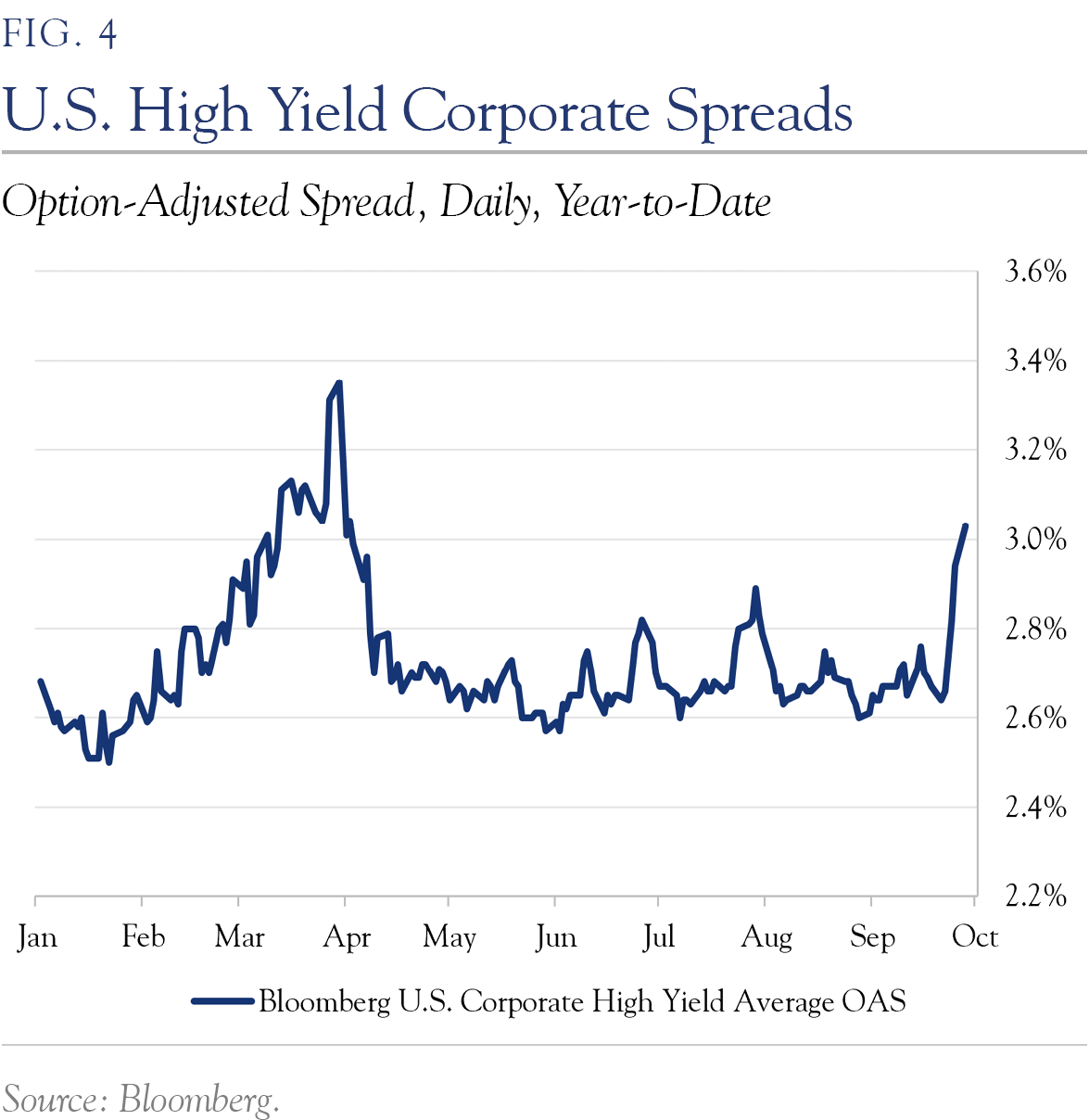
While some individual issuers are showing stress in the form of rising credit default swap spreads, the broader credit market, both high yield and investment grade, generally remains quite strong, with spreads ticking up a bit in recent weeks.
Growth that is fueled by debt must eventually show a return on investment, and the clock is starting to tick down to a day when revenue and productivity gains are visible. There are two potential risks against this tsunami of AI-led growth. One risk, though likely several years out, is a slowdown in activity once companies have built what they need, which would in turn suppress economic growth. The second, and in our view more significant, concern is that any delay in revenue generation could create issues servicing this debt, raising concerns about long-term financial viability. In late September, there was a lot of buzz over a force majeure filing from a large technology company related to the timing of a data center facility coming online and contractual payments related to that data center. Arguably, some of the fear over timing delays stems from the AI buildout being larger than anticipated. This has caused problems with electricity availability and other supply chain issues. AI has also become somewhat politicized, with a range of views and debates in communities set to host data centers. This too has led to delays in permitting and other hurdles that must be overcome for data centers to be built. For now, we believe financing is solid, demand is strong, and any disappointment will likely come from timelines extending further than planned, thereby suppressing IRRs. In other words, a risk to the projected return on capital, not a risk to the return of capital.
Treasury Turmoil?
Towards the end of summer, financial market professionals and denizens of resort towns across the country were riveted by the jousting between Treasury Secretary Scott Bessent and his former mentor, Stan Druckenmiller. With yields on the U.S. ten-year note creeping higher, Bessent made comments and open-market adjustments intended to limit the rise in yields. When the increased treasury buybacks were initially announced, we thought they could serve as an effective trial balloon, creating a bit of pushback to traders, yet small enough to be seen as a technical adjustment rather than an urgent, important action. However, Bessent upped the ante, deciding to speak loudly while claiming to carry a large wallet. Meanwhile, Druckenmiller took to the Wall Street Journal opinion page to highlight the problems with Bessent’s approach and outline the very real challenges created by persistent budget deficits and a growing national debt.
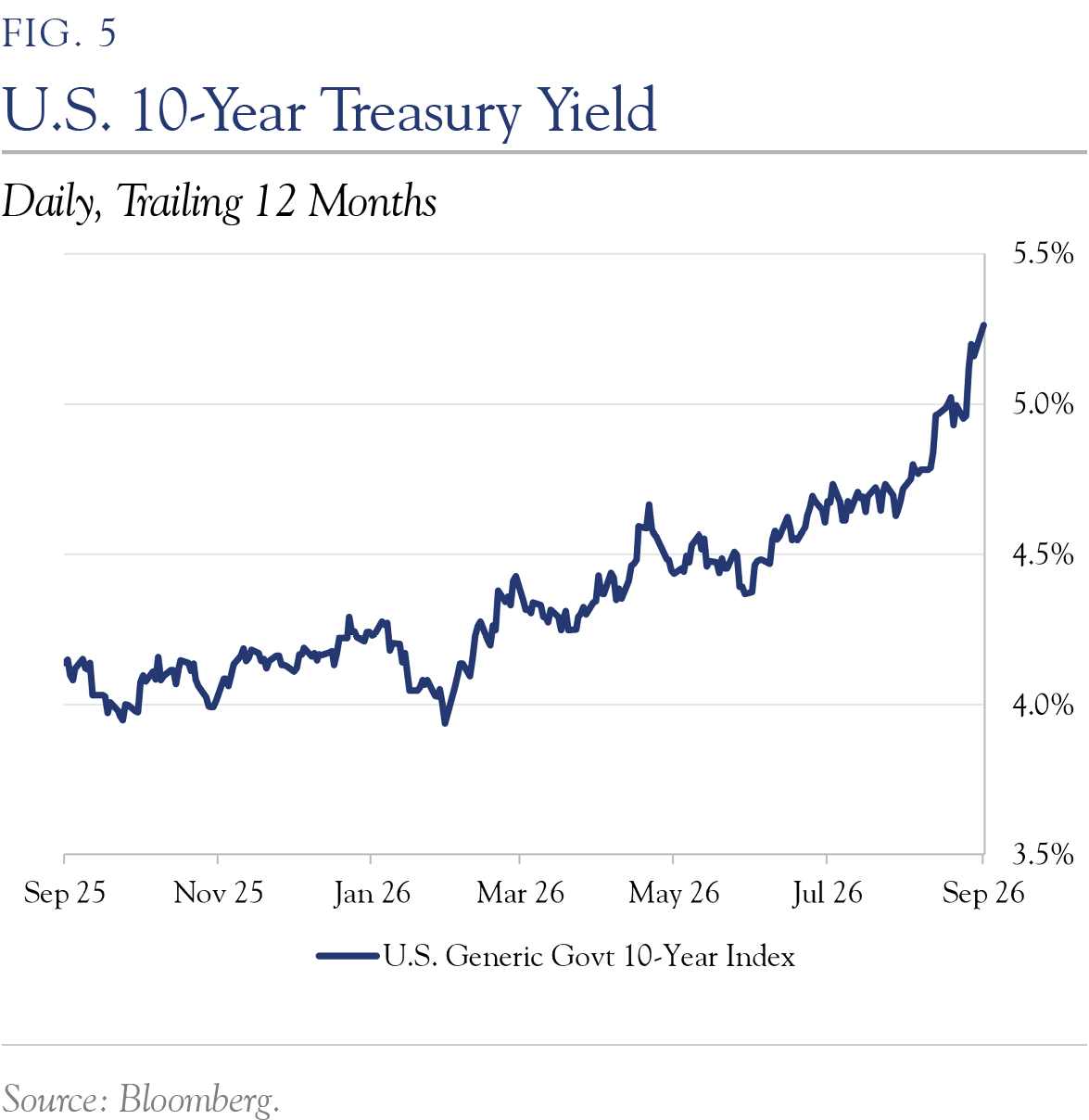
Despite the challenge from the deficit and debt, capital flows unfold on a relative basis, and the U.S. has a better demographic and economic growth backdrop than other countries with similar debt/GDP levels. Simply put, U.S. assets remain compelling on the global stage.
While yields marched higher during the very public spat between Druckenmiller and Bessent, they did so against the backdrop of ever-higher oil prices. With marine traffic through the Strait of Hormuz still severely restricted, persistent high oil prices and ongoing inflation fears are likely major drivers of the rise in yields.
As for Fed Chair Warsh, the recent increase in the Fed Funds Rate might add credibility to his inflation battle, though it won’t do much for oil prices and also raises the risk of higher interest-rate costs on debt.
A big concern for inflation/rates is that something else goes wrong with Hormuz/oil. That is still a possibility. However, China has become a major short-term swing factor in oil, via its substantial strategic reserve and shift to electric vehicles. Absent some dramatic change in U.S.-China relations, it is reasonable to expect that, in the near term, China will also aim to keep a lid on oil prices. If so, then some of the pressure on inflation and rates will stabilize, even if oil prices remain around current levels.
Outlook
Careful comparisons of the AI era’s size, timing, and profitability to the Internet era reveal similarities, but also key differences. While the current buildout is similar in scale and has a timeline that suggests it could be in a late stage, the bulk of the public companies involved in today’s AI era compare favorably to their Internet-era counterparts. As we first outlined in 2024, we expect many future benefits to accrue to users of the technology through productivity gains and profit margin expansion. This is easier said than done, which is why we anticipate meaningful divergence between companies that adapt and those that don’t. Like any major transformational economic event, there will be some collateral damage. Not every data center or AI model will be profitable. There will be failures. However, to date, most financial activity is happening with firms and investors who can tolerate and manage reasonable amounts of risk.
The outlook for earnings is incredibly bright, and we expect that to be the primary driver of stock direction. A change in the rate of change could create problems for some overheated areas and will likely bring some attention to neglected areas of the market, particularly well-managed smaller companies.
Because of the long list of macro concerns, some of them highly unpredictable, we continue to favor a neutral risk posture—that is, allocating risk at a level that is consistent with long-term objectives, not more, not less.
We also strongly advocate for diversification. While the AI era will likely remain the key driver of economic and market activity, it is important not to put all eggs in that one basket. Many investments which aren’t obviously AI-related are tied to the AI trade, particularly in U.S. Large Cap. Therefore, diversification into areas outside the U.S. can be additive.
On credit risk, we continue to emphasize security-level work, taking credit risk only where it aligns with strong research. With yields above five, bonds can provide a nice dose of safety and income when held to maturity. Overall, we see it as a time to be optimistic, but careful.
This communication contains the personal opinions, as of the date set forth herein, about the securities, investments and/or economic subjects discussed by Mr. Teeter. No part of Mr. Teeter’s compensation was, is or will be related to any specific views contained in these materials. This communication is intended for information purposes only and does not recommend or solicit the purchase or sale of specific securities or investment services. Readers should not infer or assume that any securities, sectors or markets described were or will be profitable or are appropriate to meet the objectives, situation or needs of a particular individual or family, as the implementation of any financial strategy should only be made after consultation with your attorney, tax advisor and investment advisor. All material presented is compiled from sources believed to be reliable, but accuracy or completeness cannot be guaranteed.
© Silvercrest Asset Management Group LLC