





Fantastic Fundamentals vs. Fissures and Fragility
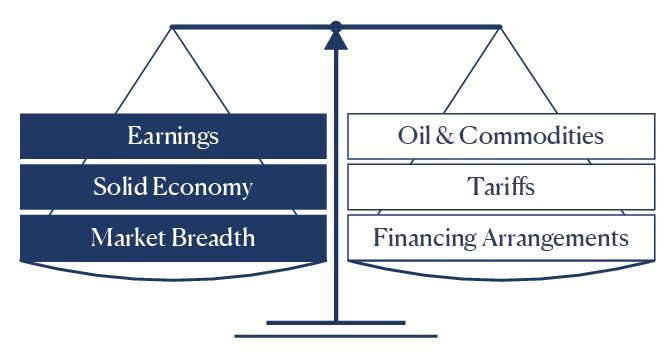
Among the many debates across markets today, the conflict between fundamentals and fissures is the most consequential.
Fundamentals
Much of the fundamental backdrop is in fantastic health, ranging from a solid but “boring” labor market to a blockbuster earnings backdrop.
Powerful Earnings Season
The second quarter earnings season was one of the most impressive in recent memory. Actual growth rates and how much growth exceeded expectations were both extraordinary. Profit margins also continued to expand. The only weak spot was earnings breadth, which wasn’t particularly wide, as the strongest earnings gains were concentrated in technology and large-cap companies.
Solid Economy
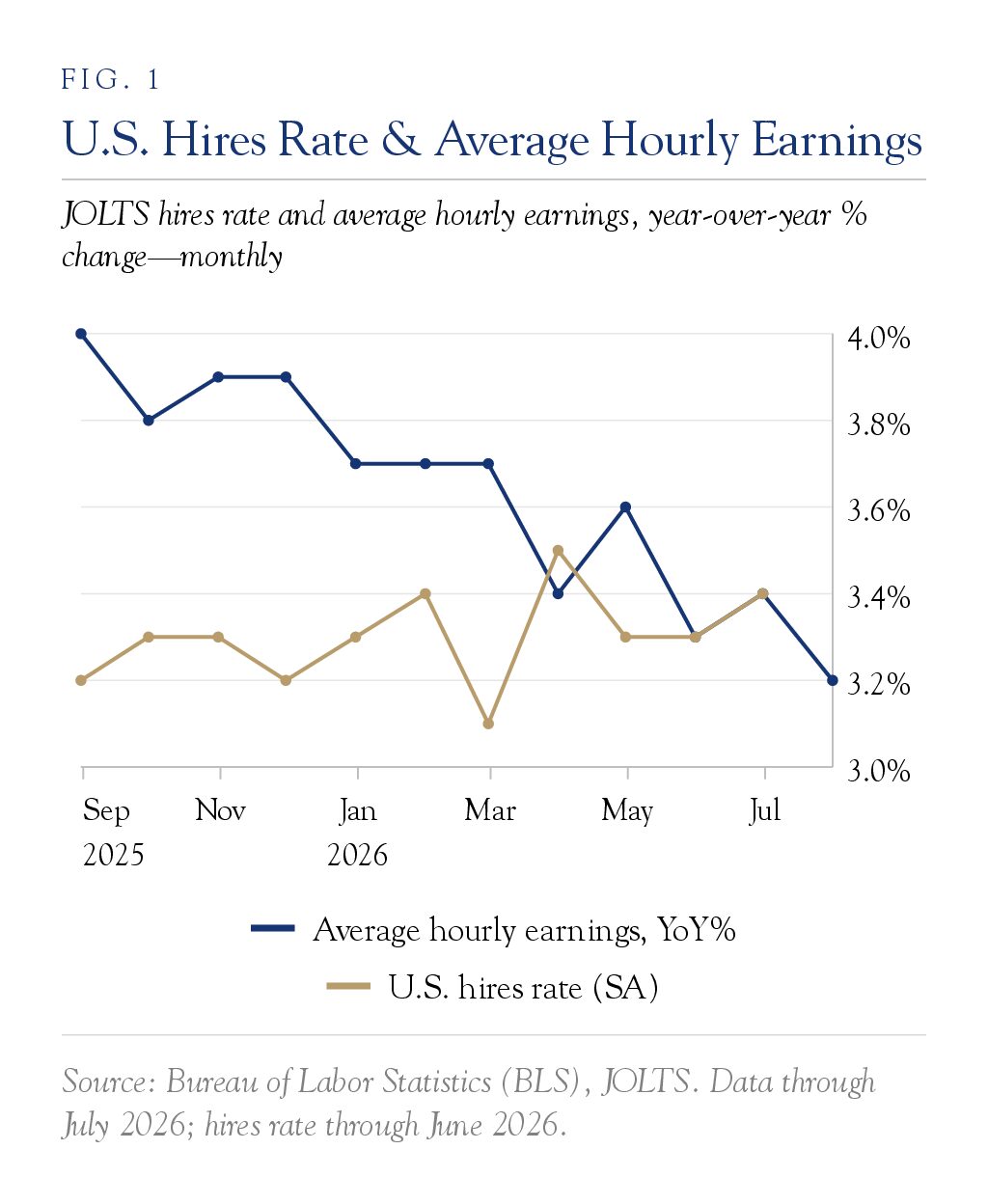
The Dallas Fed Weekly Economic Index points to GDP growth of +2.9%, while the Atlanta Fed’s GDPNow Index estimates growth at +4.6%. Meanwhile, despite a gradual slowdown, wages continue to rise, and payrolls continue to expand. Figure 1 shows the change in average hourly earnings and the Hires rate of payroll expansion. In other words, the economy and consumers are fine.
Market Breadth
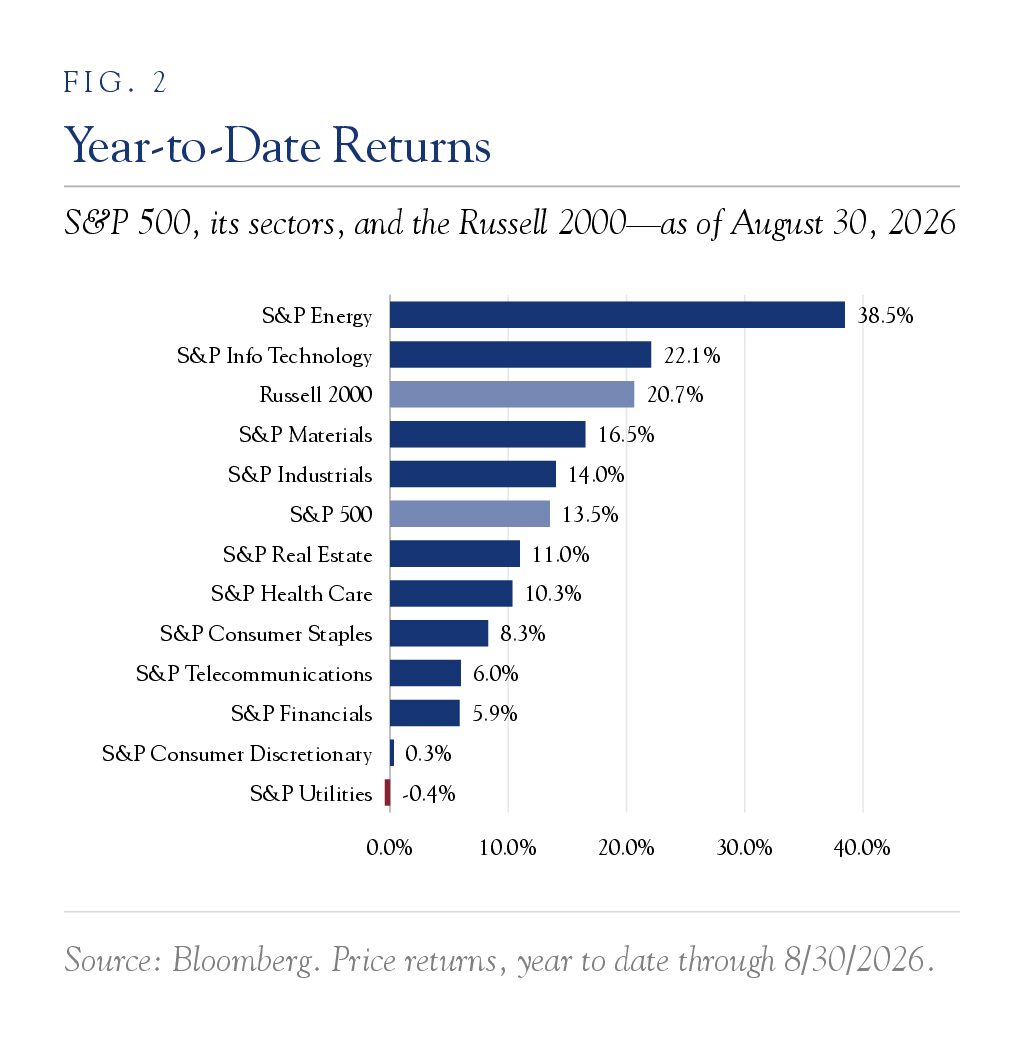
This year has seen strong price action across all market cap segments and investment styles, with six S&P 500 sectors posting gains above 10%. This broadening of returns is typically a healthy sign of a durable equity market rally.
Taken together, these points would seem to be the end of the story. However, fissures are creating fragility across a range of macro issues.
Fragility
Oil & Commodities
Since the start of the conflict in the Strait of Hormuz, a patchwork of responses has aimed to keep oil flowing globally. A wide range of workarounds for transporting oil exists, and China has emerged as a major swing factor, drawing down inventory to avoid being forced to import at higher prices. Eventually, the redundancies created by alternate transit routes could create a more robust system. For now, a lot of things need to keep working to maintain balance in the oil market, such as avoiding military action spreading to other transit routes or a change in China’s approach to the situation. Recent news in Venezuela is another example of a change that may ultimately be positive for U.S. access to oil, but it is far too early to know how this will affect week-to-week inventory management.
In addition to oil, other commodities flow through the strait, some related to agricultural needs. Agriculture faces another possible challenge in the form of a strong El Niño weather pattern. Prior instances of similar strength have created a tough backdrop for some agricultural products.
Tariffs
While tariffs remain a relatively minor issue for overall economic growth, they do introduce unpredictability for business planning. New volleys against Canada come just as refunds of earlier tariffs are coursing through the system. As with the initial round of tariffs, context is important. The recent spat between the U.S. and Canada is important in a geopolitical context. Yet, any changes in trade patterns are likely to be minor relative to overall trade, though they may hit harder in select areas. Global research shop Rane noted recently that “Canada will seek to accelerate a deeper, sector-specific strategic relationship with the European Union, particularly in defense, critical minerals, energy, technology and Arctic security, though stopping well short of formal economic integration that could displace the United States.” At the same time, they provide the important data and context that “While E.U.-Canada trade is increasing, only 8% of Canada’s goods exports went to the European Union in 2024, compared to roughly 75% going to the United States.”
Financing Arrangements
Some earnings announcements included significant gains from markups of asset holdings in AI-related companies. That’s not a bad thing, but it isn’t necessarily sustainable or predictable. Less clear during reporting season and beyond are the wide-reaching but hard-to-measure effects of the major uptick in debt financing fueling the AI boom. In many cases, it is not fully clear who bears responsibility, and the practices do share some resemblance to financing practices seen in other boom eras.
China
China influences the global economy in a number of complex ways. While the domestic economy, especially among consumers, isn’t especially robust, there is a desire to project stability and consistency. Further, China’s influence via rare earths and its ability to “flex” its demand for oil give Beijing significant power to shape the global economic playing field.
Market Breadth
No, this isn’t an AI typo; market breadth is generally perceived to be a sign of a healthy ongoing rally. However, the current environment seems to lack any enthusiasm for smaller-cap companies. Is the rotation as positive as it appears? Are investors moving toward something or away from something by lightening up risk in large cap? There is no easy answer, but the rotation can be read two ways, given the lack of clear conviction and earnings follow-through from small cap.
Credibility of the Fed and Treasury
The Jackson Hole comments from new Fed Chair Warsh were well received and seem to have gone a long way toward boosting the credibility of the current Fed. It is early days in his tenure, so the foundation is still being built. At Treasury, Secretary Bessent has good instincts for when to weigh in with a view; however, the recent shift from small changes in announced purchases to increasingly loud commentary hasn’t been effective in lowering interest rates. Both institutions have high credibility, but they are under intense market scrutiny.
Credibility of the Fed and Treasury is especially important in an era of high debt and ongoing deficits for the United States. The ownership base of U.S. Treasuries has shifted over time, with the mix shifting away from foreign entities toward domestic holders, often hedge funds.
Foreign Buyers of U.S. Assets
Foreign interest in U.S. assets remains high. With equities, this can be seen in the valuation differential between U.S. and non-U.S. equities. A large part of this difference can be attributed to differences in sector mix and growth rates. Still, the compelling backdrop for U.S. earnings growth continues to attract capital from abroad. Long-term demographic and growth factors, and the central role of the U.S. Dollar, continue to make the U.S. a good home for global capital. However, with foreign interest already so high, one must ask whether foreign buyers could be enticed to purchase even more. Probably not, so global flows likely remain neutral rather than a net new positive.
Outlook
While there are far more fissures than strong fundamental stories, fundamentals are typically the more powerful force. A solid economy and powerful earnings create an incredible tailwind for stocks. For now, we conclude that fundamentals will dictate the path and send equities in a positive direction. However, given the somewhat fragile state of global macro affairs, we keep exposure in a tightly monitored range, aiming to stay on long-term risk targets. Recent volatility in the U.S. Treasury bond market with yields punching toward the 2023 high near 5% adds another layer of complexity. Careful examination of risk levels across equity beta, duration risk in bonds, and credit risk is timely. This complex environment will reward classic concepts like rebalancing and staying diversified.
This communication contains the personal opinions, as of the date set forth herein, about the securities, investments and/or economic subjects discussed by Mr. Teeter. No part of Mr. Teeter’s compensation was, is or will be related to any specific views contained in these materials. This communication is intended for information purposes only and does not recommend or solicit the purchase or sale of specific securities or investment services. Readers should not infer or assume that any securities, sectors or markets described were or will be profitable or are appropriate to meet the objectives, situation or needs of a particular individual or family, as the implementation of any financial strategy should only be made after consultation with your attorney, tax advisor and investment advisor. All material presented is compiled from sources believed to be reliable, but accuracy or completeness cannot be guaranteed. © Silvercrest Asset Management Group LLC